

Mobility Matters: Supporting senior healthspan with the Kiwanis Club
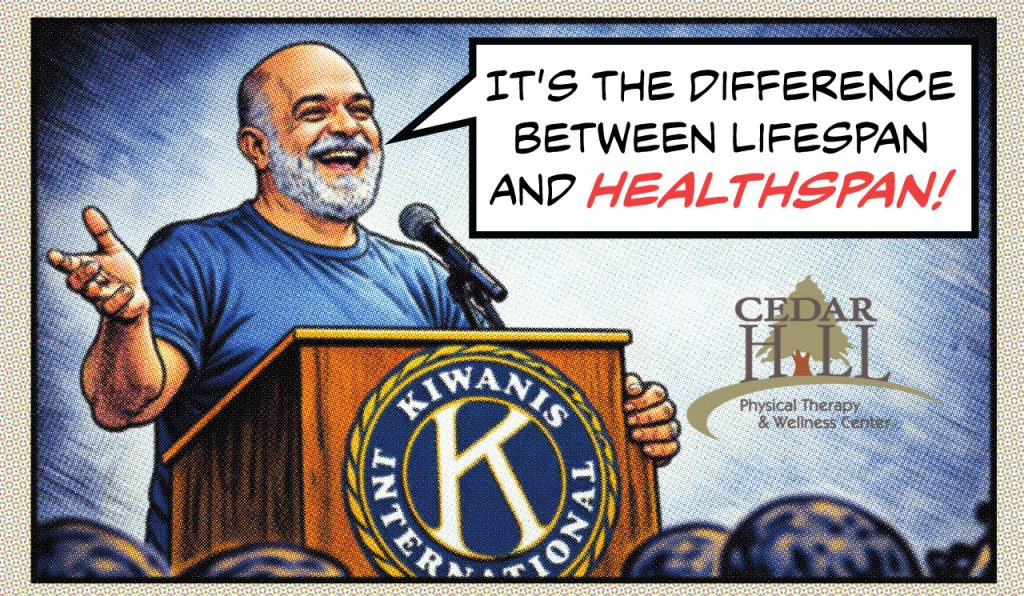
Recently, I had the pleasure of speaking with the Edward R. Murrow Kiwanis Club at Leonard Recreation Center in Greensboro, NC. My subject came easily, as it’s something I think about every day.
It’s the difference between lifespan and healthspan.
Most people are familiar with lifespan. That’s simply the number of years we live.
But let’s ask a more practical question: How many of those years are we able to live well? Because that’s what healthspan is.
It’s all about the number of years we remain capable of doing the things we want to do: walking comfortably, getting up from a chair, climbing stairs, traveling, playing with grandchildren, etc. From a physical therapist’s perspective, healthspan comes down to my patients’ abilities to still do what they want to do with their bodies.
One of the stories I shared with the gracious Kiwanian audience involved my grandmother, Edith. Late in her life she fell, broke her hip, and spent the remainder of her days confined to a hospital bed. It’s a story that unfortunately plays out all too often.
That experience raises a question: Could a physical therapist have helped her before that fall ever happened?
I believe the answer is yes.
A preventive and empowering form of health care
Much of what physical therapists do involves assessing fall risk and mobility. We look at how people walk, how they balance, and how easily they move from sitting to standing. Something as simple as walking speed can reveal a great deal about someone’s overall health and independence.
In fact, researchers increasingly treat walking speed as a kind of vital sign. (Read my article on gait speed here.) If someone walks slowly, it often correlates with poorer health outcomes. If someone walks briskly, they are generally more capable of caring for themselves and remaining independent.
What many people don’t realize is that physical therapy isn’t just for recovery after injury or surgery. In many ways, it’s one of the most preventive and empowering forms of health care available.
Unlike treatments that rely primarily on medication, physical therapy gives patients tools to help themselves. Through approaches like the McKenzie Method, patients learn exercises and movements that can reduce pain, restore mobility, and build resilience.
Th